

September 2026 | Newsletter from Vital Fitness Testing
Business Updates:
We have been operational for 9 months now, and I think at this point we have refined all aspects of the testing experience. Our goal remains the same with each study--to make the experience as fun, positive, and informative as possible. We want to help each individual meet his or her fitness goals.

Through the summer we have had mostly runners come through for testing. With each runner, we try to customize the protocol to best suit the runner’s speed and power allowing for a 4-to-5-minute warm-up followed by a steadily increasing workload. The goal is to achieve cardiopulmonary fatigue within 12-15 minutes of warming up, before leg fatigue sets in. If we get the protocol wrong or anything about the testing experience is suboptimal, we will repeat it free of charge until we get it right.
Exciting News:
Dr. Z gave a brief presentation to the Rhode Island Interscholastic League cross-country coaches meeting earlier in August. We are offering full VO2 max testing and reporting to all high school athletes for a discounted rate of $50. We will be adding a feature to our website for easy booking, but for now, interested coaches and athletes are encouraged to reach out to Dr. Z via email at vitalfitnesstesting@gmail.com to schedule.
Vital Fitness Testing has signed on as a proud sponsor for the OctoberVets 5 km road race in Wickford on 10/17/26. If you are local, please sign up for this run/walk, as 100% of the money raised from sponsors and race registration supports local veteran charities. We will host a tent in the town parking lot after the race. Come see us!
We have also signed up as a sponsor (featured with a two-page spread in the program) for the Ronald McDonald House 2026 Women’s Classic in Providence. This charity run supports the amazing work done by the Ronald McDonald House of New England.
We are offering testing for $50 to the first 10 runners who agree to share their wearable-derived VO2 max and zone 2 heart rate range to compare with what we measure by metabolic stress testing. If you are interested, e-mail Dr. Z at vitalfitnesstesting@gmail.com
And the really big news: Dr. Z has written a Vital Fitness Testing jingle. The VFT team will be recording it live sometime this Fall. We will be sure to document the recording process to share.
Wickford Run/Walk Club:
We meet every Saturday at 9 am outside of Vital Fitness Testing. Check out our Instagram page and our Strava group for weekly routes and special announcements. A few weeks ago, we ventured out for a longer run to check out the new troll in Ryan Park (pictured here).

Last weekend, we partnered with Club Wellbeing for a group walk/ run and a discussion about why VO2 max is the most important indicator of overall health and wellness. We would love to have more walkers join our weekly group this Fall!
Our Rhode Island Grand Prix team has one race left: the Newport Half Marathon in October. After 6 races, Erin Hurley, who assists with our day-to-day operations, is in first place among the female RIGP runners! Our overall team remains in the middle of the pack. The races have been very fun with a competitive yet supportive camaraderie among members from different teams. We are hoping to expand our team for next season. Any Wickford Run Club attendee (all paces, all ages) is invited to join next year’s team!
Shoutouts:
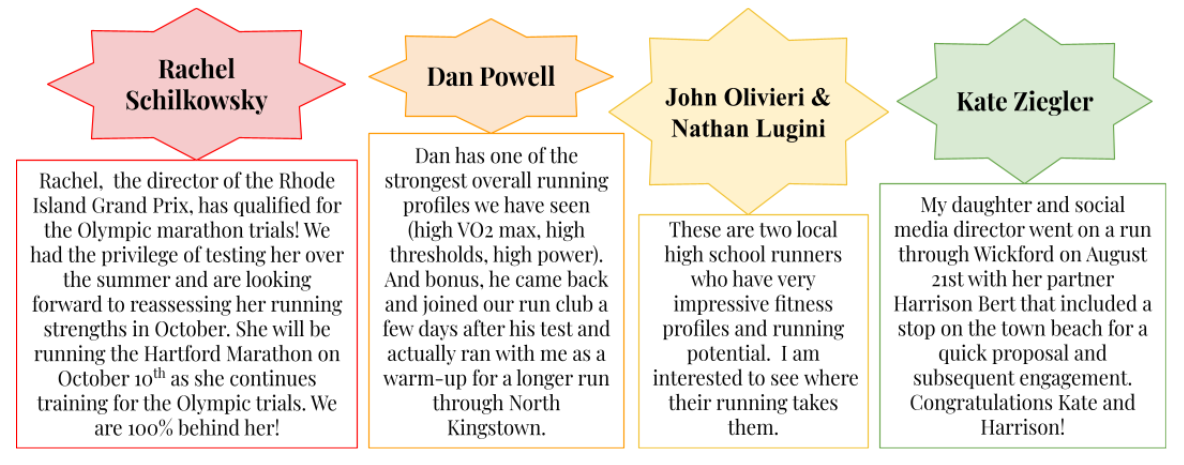
Following up on Zone 2 Exercise:
In our last newsletter sent out in June, we highlighted the physiologic basis and the benefits of zone 2 training. In early August, I ran with the Run Newport Tuesday evening run club and spent the run discussing zone 2 with running coach (and good friend) Joe Lee. As an aside, Joe was very helpful with the start-up of Vital Fitness Testing, and I am hoping to partner with him in the future as we continue expanding our brand and service lines. During the run, he asked me to better clarify zone 2 in more descriptive terms. I will attempt to break it down better.
To review, most models of training emphasize five heart rate zones, each zone representing a level of exercise intensity, each with underlying, measurable physiologic anchors, and each zone important for different reasons. If one starts moving and gradually increases speed from walking to power walking to jogging to running to sprinting, the body needs to supply skeletal muscle an ever-increasing amount of fuel (fat and carbs) and oxygen (to allow fuel conversion into energy). In terms of the supply side of things, that’s the heart’s job, and heart rate and stroke volume (how much blood is pumped each beat) both increase 2.5-4 times over baseline values at maximal exercise. In terms of fuel, fat is the most abundant energy source in the body. It is stored in muscle cells and can also be mobilized from the liver and other organs and transported via the bloodstream to muscle. Fat is the major energy source during low intensity exercise. It can only be broken down aerobically (in the presence of oxygen) in the mitochondria of skeletal muscle cells.
Fueling sources make complete sense from a survival standpoint. Humans were designed to endure as hunters/gatherers. Relative to other animals we are slower, but we can go longer, largely because we have plenty of fat stores to fuel us for prolonged low intensity movement. The problem with fat as a fuel is that it cannot be mobilized and utilized quickly. It is a great initial fuel during lower intensity exercise when skeletal muscle fuel needs are low and easily satisfied. When running speed increases beyond a certain pace, muscle energy needs also increase, necessitating a more easily “metabolizable” fuel. Glucose meets that need. As exercise intensity continues to increase, the main fuel source for muscle switches from fat to carbs. At a certain exercise intensity (or running speed), carbs take over as the primary fuel source, fat burning drops (eventually to zero during very high intensity as carbs become the sole fuel source), and lactic acid (or lactate) a byproduct of carbohydrate (glucose) metabolism, begins to accumulate.
Zone 2 includes the exercise intensity (and the associated heart rate range) that encompasses maximal breakdown of fat for fuel, through the switchover to carbs predominating, to the point where enough carbs are being metabolized that there is a slight accumulation of lactate in the bloodstream. The point when lactate starts to rise above baseline level (~ 2 mmole/L) is called the aerobic threshold (defined as VAT1 during VO2 max testing). Up to VAT1, serum lactate is low (< 2 mmole/L). Past VAT1, the body adjusts to the slight increase in lactic acid production with a more rapid rise in ventilation (resulting in an inflection point if one graphs ventilation against oxygen consumption). So, zone 2 extends from so called fat max (the maximal use of fat as fuel) to VAT1 (the point when glucose has taken over as the predominant fuel and lactate production exceeds lactate clearance). Exercise intensity below maximal fat oxidation is zone 1 (typically warm up and cool down territory), and exercise above VAT1 is zone 3 (typically tempo pace). See the graph below for a visual representation.

If an individual’s cardio fitness level is thought of as a triangle, the apex of that triangle is VO2 max, and the base is zone 2. Metabolic stress testing will define heart rate zones, but if you don’t pay attention to a wearable device, the other way of defining zone 2 is by perceived exertion. On a one to ten scale (with 1 equivalent to lying in bed and 10 completely max’d out), zone 2 is the intermediate range, mostly 4-5, sometimes bordering on 6. If you can hold a conversation while running, you are probably in zone 2. You will be breathing hard enough that someone on the phone with you will know you are exercising. If you can only get one or two words out at a time, you have moved into a higher intensity zone.
From training and wellness standpoints, lower zone 2 near maximal fat oxidation is very good for muscle cell and mitochondrial health. It is a level of exercise that optimizes the metabolic benefits of exercise while minimizing the risk of injury or over-training. Upper zone 2, near VAT1 will build your aerobic base over time allowing for more speed in the mid, completely aerobic, comfortable exercise intensity range. You will get “comfortably faster.”
For new and especially for older runners, building / maintaining a strong base and avoiding injury are the most important goals. Using myself as an example– a 69-year-old runner who still loves to exercise and specifically loves to run but is injury-prone– I very mindfully try to keep all of my runs in zone 2. I still think about improving my performance, but my main goal on every run is to enjoy myself, minimize my risk for injury, and recover quickly. I do all interval work on my Peloton, as I can push harder on the cycle without worrying about injuring myself, and if I do a hard cycle work-out, I allow myself time to recover. I do not run for at least a day. When running road races, I push myself harder. Also, on days when I feel exceptionally strong, I run harder and ignore my heart rate. I go with how I feel.
I am frequently asked the following questions:
“Is spending time in zone 1 a waste?” My response to that question is NO. No exercise is wasteful. The current western societal sedentary lifestyle is killing us, so any movement is better than no movement. Zone 1 exercise (comfortable walking) still helps metabolic and cardiovascular health. It will not make you faster, and it will not improve your fitness level beyond a certain point if you are never moving out of zone 1. But if your main goal is to move and maintain and you hate to sweat, and especially if you are over sixty, I strongly support daily walks. I utilize long walks on recovery days. Any level of exercise is good!
Is weight training detrimental to cardio fitness? The answer is a resounding NO, unless weight training is the only form of exercise in which one engages. Weight training is absolutely good. It helps maintain muscle strength and health, lean body mass, and bone density. In combination with cardio training, especially three to four long zone 2 sessions per week, it is a perfect balance for maintaining a strong, complete fitness and strength base. A caveat—weight training will not improve your running endurance.
Is only doing high intensity cardio work-outs bad? Again, the answer is NO, unless your goal is to perform well in endurance events such as road races. There is specificity to how one trains, meaning you become strong at what you train for. High intensity work outs will help you perform well at burst type activities such as structured sports like soccer or shorter distance runs, maybe up to a mile. Just don’t go run with a group of seasoned long-distance runners and get frustrated when you know you are strong, maybe even with a higher VO2 max than those runners, but you cannot keep up for a 5 or 10 km run.
As always, if you have questions regarding the above, please e-mail me at vitalfitnesstesting@gmail.com. We will probably continue the discussion about heart rate zones in the next 2-3 newsletters. If there are other topics you would like us to take a deep dive into, please e-mail me. We hope everyone has a great end-of-summer and we hope to see you this Fall!

Comments